

Dog Mama
The results of Chita's DNA tests are in, and it's not what you probably thought

If you’re thoroughly disgusted reading about cage matches and other desecrations of our democratic institutions, there are always dogs to think about. This post is all about dogs.

First: The results are in!!
I sprang for Chita’s DNA test, and held a little contest to see who could come closest to guessing her breeds. Though everyone thought Dalmatian, including the vet, it turns out she has zero Dalmatian. Here’s her very Mexican mix:
35% Chihuahua
25% Toy and Miniature Poodle
22% Miniature Pinscher
5% Standard Poodle
4% Xoloitsquintli (ancient Mexican breed, Frida Kahlo’s hairless dog)
3% Pekingese
2% Weimeraner
2% American Pit Bull Terrier
1% Eastern European Ovchaka
Congratulations to Michael Ostacher and Theresa Parise, who tied for best guesses and will win spotted socks and a book!
People who know about dogs say that there is a formula for rescue dogs: 3-3-3. It’s three days when they’re scared, in shock, and need to get used to their surroundings, when they’re not likely to eat, drink, sleep, or poop normally. Three weeks to develop a routine and some confidence, which is three weeks when they’re likely to cling to their owner. Then it’s three months for them to feel entirely comfortable and let their personalities emerge.
The first day I rescued her, after she was bathed, clipped, and outfitted at Petco, my friend Dan dropped Chita and me off at my house in San Miguel de Allende, and I was alone with her. It hadn’t quite sunk in that I’d just made a 10-year commitment to this creature. My husband, who wasn’t along on the trip, still had no idea what I’d done.
I tried to give Chita one of the treats I’d bought to make her feel at home. She sniffed and turned away, either too scared or not motivated by food—or both. She was suspicious of her new surroundings—a narrow house (3.5 meters) with lots of stairs, and a patio in the middle, with a lot of green plants, but no yard.
I did what I always do when I dogsit: I set out her new bowls for water and kibble, and filled them both. She immediately scarfed all her kibble. Now what?
I picked her up and set her on the couch next to me, and held and pet her for a long time. This seemed to calm us both down. “Buena Chita,” I said, so she could get used to her name. She’s Mexican, so she hadn’t learned any English yet. I sat there with her while I called my husband and sister and told them I’d just adopted a dog, sending them photos. My sister was thrilled, and marveled over Chita’s transformation from rasta dog to elegant mini spotted poodle. My husband, who’d had time to get used to the idea in the abstract—I had run the idea by him—thought she was cute, and was positive about the whole venture, but had a lot of questions: How was I going to get her home? When? Would she fit under an airplane seat? I told him I still had a little research to do on those fronts.
I hadn’t thought it all through in advance.
I know adopting Chita was impulsive. I’m impulsive. Buying a run-down shell of a house in Mexico had been impulsive, too, but with time and an architect, it had worked out. I had an intuition that scruffy little Chita was also a good decision, a necessary one—for her, and maybe for me. Sometimes you have to listen to your impulses or you miss out. You can’t go through life overthinking things.
After a couple of hours I wondered whether Chita might need to go out. It had been several hours since my friend and I had picked her up at the hacienda and taken her to the groomer and vet. I didn’t know if she was even house trained, though she hadn’t had any accidents since she’d been inside.
“Vamos,” I said, which would become our word for “Let’s go out for a walk.” I attached her new leash to her collar and opened the door.
Though my house in the Centro is only about three miles away from the hacienda where she’d roamed around, homeless but fed at the Italian restaurant, it was another world. The streets are narrow, with single-file sidewalks. Cars and noisy motorcycles rush past with little room on the sides. Other dogs roam the streets. Terrified, Chita edged against the wall and stood stock still every time a motorized vehicle or dog passed. She had no interest in doing any of her private business.
Since she’d been an outdoor dog, I thought she might need a little outdoor space to relax. The trouble is, the nearest outdoor space was several blocks from my house, and you had to cross a busy street. We headed in that direction, and when she refused to cross the busy street, I picked her up and carried her until the coast was clear. We finally made it, stopping and vamosing, to an outdoor path along a creek. Knowing that she wouldn’t run away from me, I let her off the leash in a safe place, and she discreetly peed. That was it.
When we got home, I made her a little bed on the floor of my bedroom with towels and blankets where she curled up, a safe spot. That night, I tried her on the bed for a time, but she was so squirmy and scratchy that I put her back down on her bed on the floor.
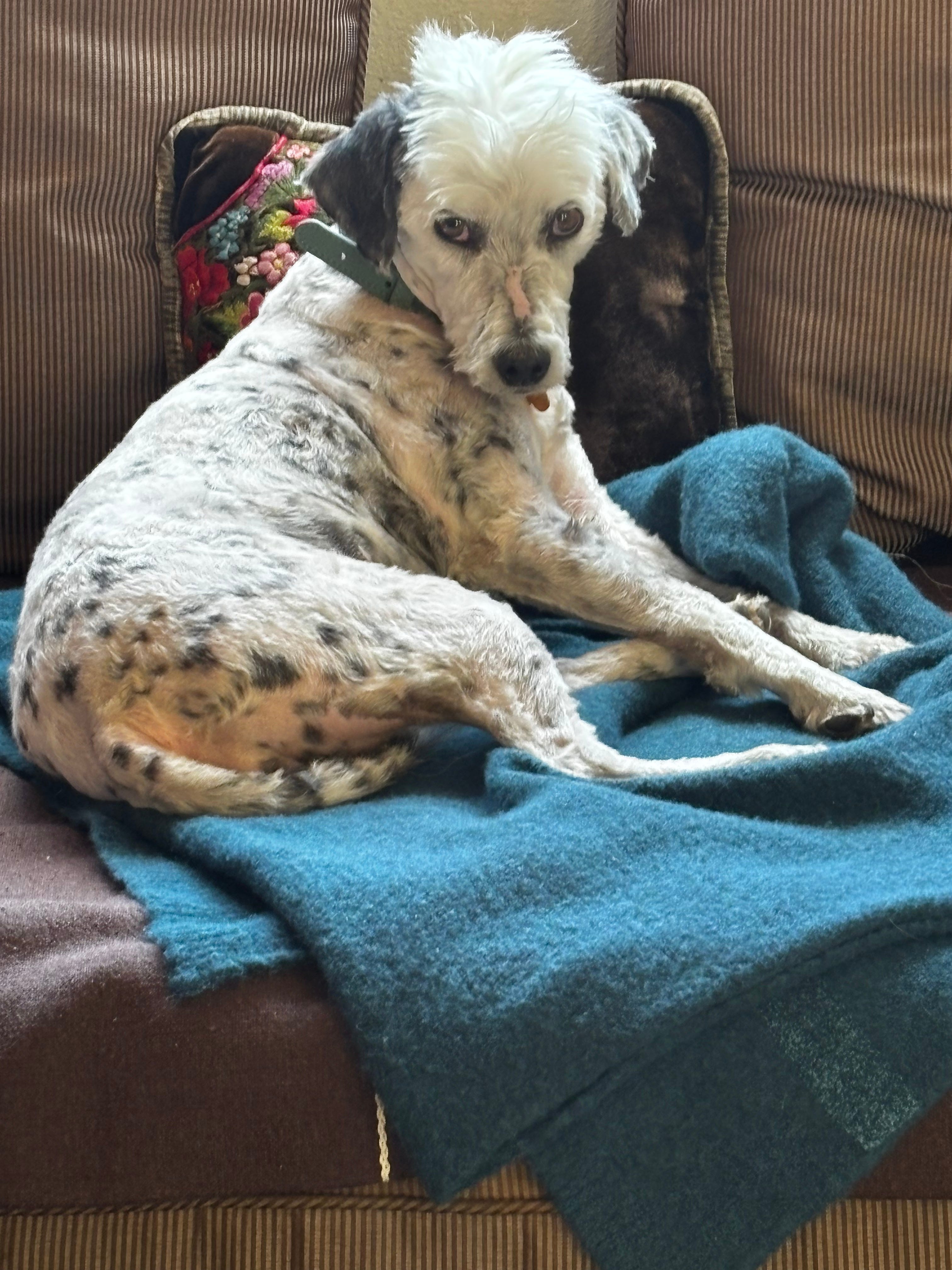
For the next two days, she wouldn’t let me out of her sight; I was her sole connection to this new world. I canceled all my plans. She followed me to the bathroom, upstairs, downstairs—everywhere but to the top terrace, on the fourth floor of my Stairmaster of a house. The vertical stairs and the distance to the ground below were too scary for her, so she climbed three stairs to where the sun hit the stairs and stopped. As on the street, when she stopped, she couldn’t be budged, and I knew enough not to force the issue
.
The second day, it was really hot out, and, wary of the traffic, I hailed a taxi to a dog park. I thought about how ridiculous that was, to take a taxi to walk your dog. I brought along some water and a little bowl for her, and let her loose in the park. She sat down next to me, pawing at me to pet her. She didn’t do any of her necesidades; an outdoor dog isn’t on a clock when it comes to doing their business, even if you paid 80 pesos to get there. She was only interested in sitting next to me, and wasn’t about to run around on her own. She was curious about other people—since she’d hung out at an outdoor restaurant, she was used to people petting her—but only as long as she kept one eye on me. When I said “vamos,” she’d leap up and come.
It wasn’t until the third day that she began eating and doing her business more regularly. I felt like a new mom, calling my sister, announcing, “She pooped!” I finally found a little open space closer to the house, in a callejon near the mercado, where an elderly man on the park bench told me she was welcome anytime. He turned out to be a retired veterinarian, and advised me to just be patient as she got used to her routine. He petted her. “Muy educada,” he said. Very well-mannered.
Chita opened up communication with my Mexican neighbors, who overheard me speaking Spanish to her. She wanted to say hello to men sitting on the sidewalk eating their lunch, to vendors in the mercado, to my neighbors. She’d just walk up to them, sit, and let them pet her, which gave me a chance to chat with a lot of people I usually would have walked past. I stopped by to see Don Rafa, my paralyzed neighbor who runs the bodega on my block, who pronounced her muy linda y tranquila, very pretty and calm. I also got a sense that the people who avoided her were best for us to avoid as well.
With Chita on my lap, I began to research how to get her back to San Francisco. She’d have to fit under the airplane seat, which worried me. She’s 20 pounds, within the limit, but long-legged. I bought the only airplane carrier Petco sold, for $140 US, but getting her in it was like stuffing a down sleeping bag, and she was not happy. I returned it and found another on Facebook marketplace for 300 pesos, about $18, where she fit just fine, though she squirmed when I tested it on her.
Before I traveled, I also needed to see the vet for a bunch of vaccinations, a microchip, a clean bill of health, and a deworming certificate. The vet, Roxanda, confirmed that she was healthy and fixed, and filled out all the papers I needed.
I had to go away for two days for a previous appointment, so I left Chita with Alfonso, the groomer who was also a vet. He raises show poodles, and said it would be good for her to be socialized a bit with some other dogs, so I reluctantly dropped her off. When I picked her up, it took her a second to realize that it was me who’d returned, then she went frantic with affection.
When we got home, I worried we were back to day one, but she settled in more easily. She’s a champion cuddler, so we cuddled. But there were more disruptions to come.
We got up before dawn the next day, and whether or not she’d been in a van for an hour and a half before, she was quiet and patient on my lap as we went to the airport. Once there, she submitted to being in the carrier, and lay down in it under the airplane seat. I opened the top of the carrier to pet her during the flight, then went to use the bathroom, and when I got back the flight attendant was holding Chita by the leash in the aisle. She’d wriggled her way out of the carrier to be with me. But she’d charmed the flight attendant.
Peter picked us up at the airport and immediately thought she was a good, sweet dog. He wasn’t convinced, even by that night, that she was the best dog in the world, but said she was growing on her. Chita was a little jealous of Peter, and vice-versa. We put her in a dog bed my sister had sent me on the floor in our bedroom to make things easier, at least, for Peter.
Chita adjusted well to San Francisco. The sidewalks are about ten times wider than in Mexico, so she felt more comfortable. She sniffed around at all the new smells—fennel! Fire hydrants! Weird new plants! All of the big dogs are less scary because they are attached to humans. She initially startled, growled, and bared her teeth at even the mildest of maltepoos, but now she’s more relaxed around other small dogs (she hides behind me when she encounters a big dog). For the first few days, as in Mexico, she followed me from room to room, including the bathroom. When I went to the park, I could take her off leash because she was basically glued to my side. But one morning, Peter took her to the park instead, let her off the leash to do her business, and she bolted back home across traffic. Peter ran to catch her, and caught up to someone who had grabbed her leash. Not used to Peter yet, she was frantic to get back to me. He’s never letting her off-leash again.
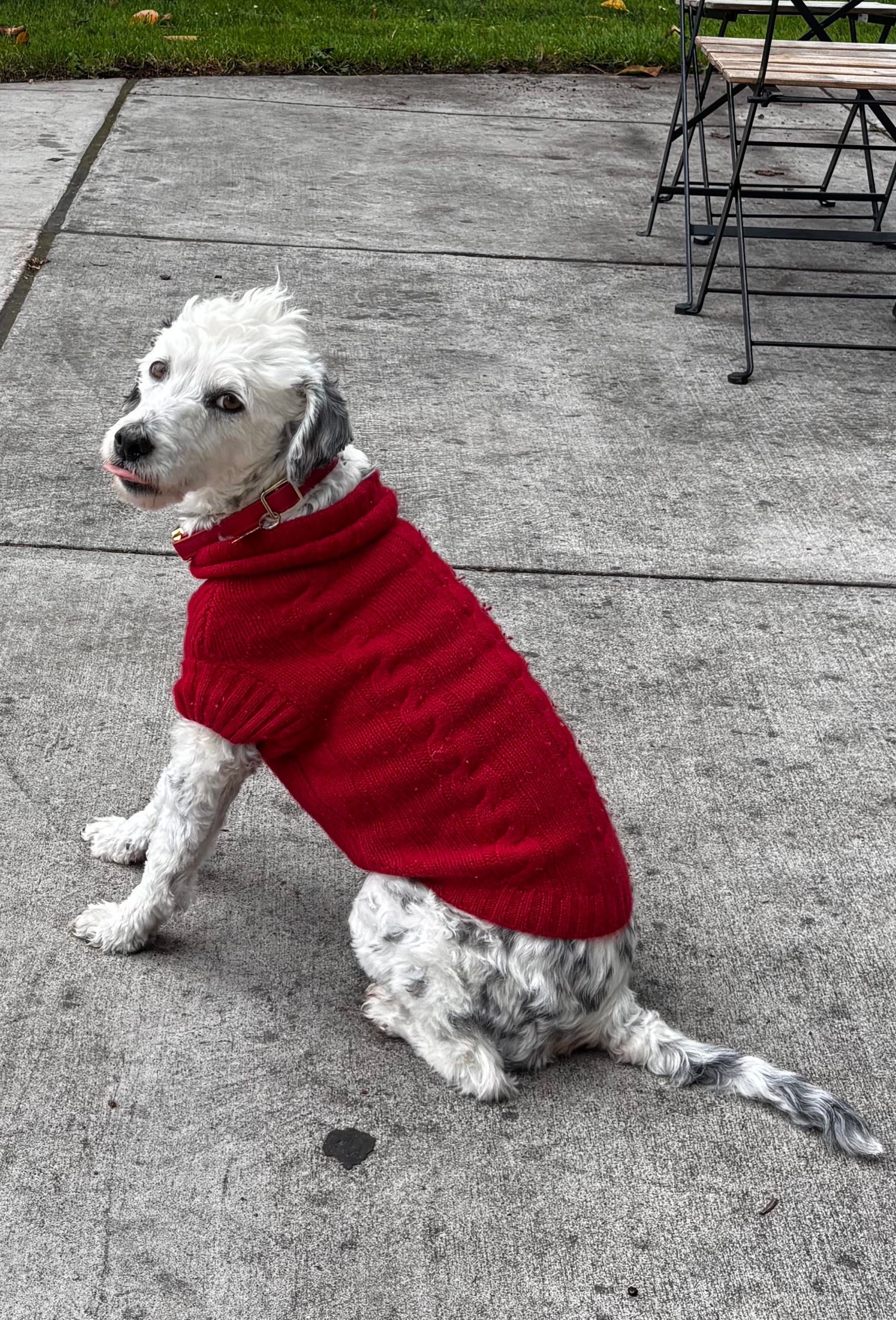
Since it was a lot colder in San Francisco, and she was shorn from her rasta fur, I bought her a sweater. I found a red sweater, which would be cute with her black and white spots. It was cashmere. I never thought I’d be a person who would buy a dog a cashmere sweater (even if it was, $43 on Quince, not crazy expensive). “Welcome to the dog industrial complex,” said my friend Karen, a doggy mama.
Here in San Francisco, as in Mexico, Chita goes up to all kinds of people to be petted. As a result, I’ve also come to know more of my neighbors here. People smile at me more, because they smile at her.
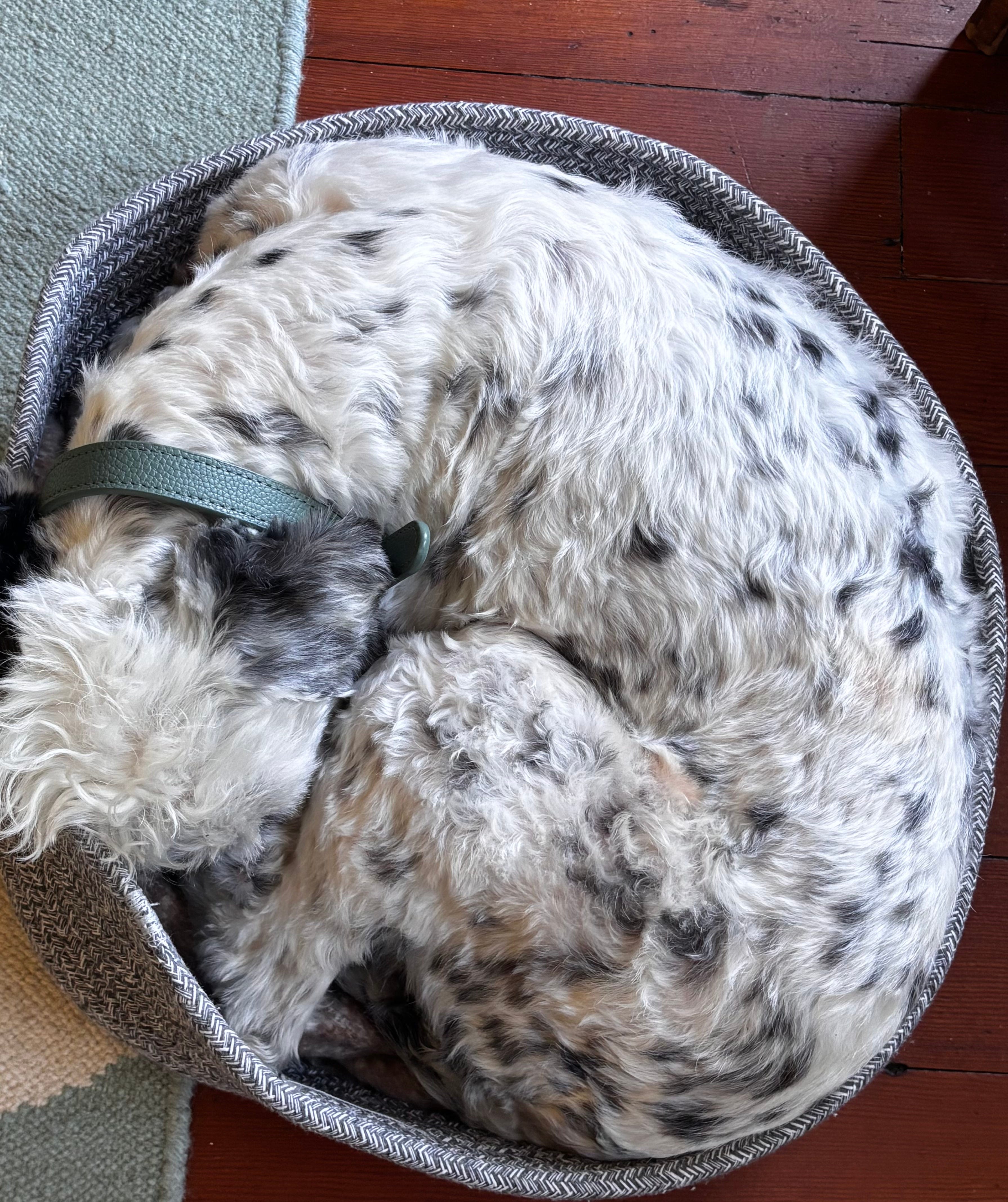
Though she had a dog bed, Chita found a basket on the floor in my office, where her body just barely fit curled up in a tight ball, where she felt most comfortable. Little by little, she stayed in her basket when I went off to other rooms. Then she began to feel a little more free about jumping up on furniture, including a high daybed in my study where she has a view of the trees. She’s beginning to greet Peter when he comes home, and stays with him when I leave the room. Poco a poco.
She’s showing a little personality. She’s starting to play. The first time I rolled a little ball at her, she ran and cowered. She still has no idea what to do with a little stuffed animal. But she’s responding to little games with me, and learning to sit, stay, and shake.
Chita eats her kibble, which I sweeten with meat scraps (she was raised, after all, at an Italian restaurant, where the chef told me he used to give her veal bones), which she also meekly eats. Recently, though, she’s been staring at me after finishing the meat scraps with an outraged expression that clearly says, “Where the fuck is more meat?”
Now, after two and a half months, Chita is showing a lot more pizazz. She’s smart. She lets Peter take her to the yard to do her business in the morning, but if I take her, she just sits there with an expression that I know means, “I’ll wait til you take me on a real walk.”
I bought a little dog basket for my bike, which she withstood with great patience. I rode her to the ocean, where she immediately sensed that this was Dog Heaven and went running like crazy, chasing birds and waves.
She’s also become much stronger. I get the feeling she didn’t get a lot of exercise before. Initially, she was slow coming up stairs, stopping a lot, but now she bounds up three flights easily. She jumps higher. Where she got pooped out initially going on a two-mile walk, now she can do four, with plenty of side visits racing up and down hills, looking for squirrels. She always comes right back when I call her.
She’s kind of a perfect dog. She doesn’t bark, bite, or chew on things; she’s house-trained and she seems to have no bad habits except needing a lot of affection, and freaking out a little when I’m gone.
It’s a new experience to be this adored. I’ve never had children, so I don’t know that maternal bond. But this dog has bonded with me, and trusts me, even when I do crazy things like take her on a Muni train or put her in a car. She bears it all with elegant patience. She lives for belly rubs, cuddles, and brushing her hair. Peter, who also adores me, is patient. She’s slowly warming up to him, staying with him when I leave the room, and allowing him to lead her down to the yard before bedtime.
But I’m her dog mama. She loves me unconditionally, despite all my human flaws. And I feel the same about her. She’s already made me a calmer, more patient, more observant person. I’m not sure which one of us is luckier to have the other.
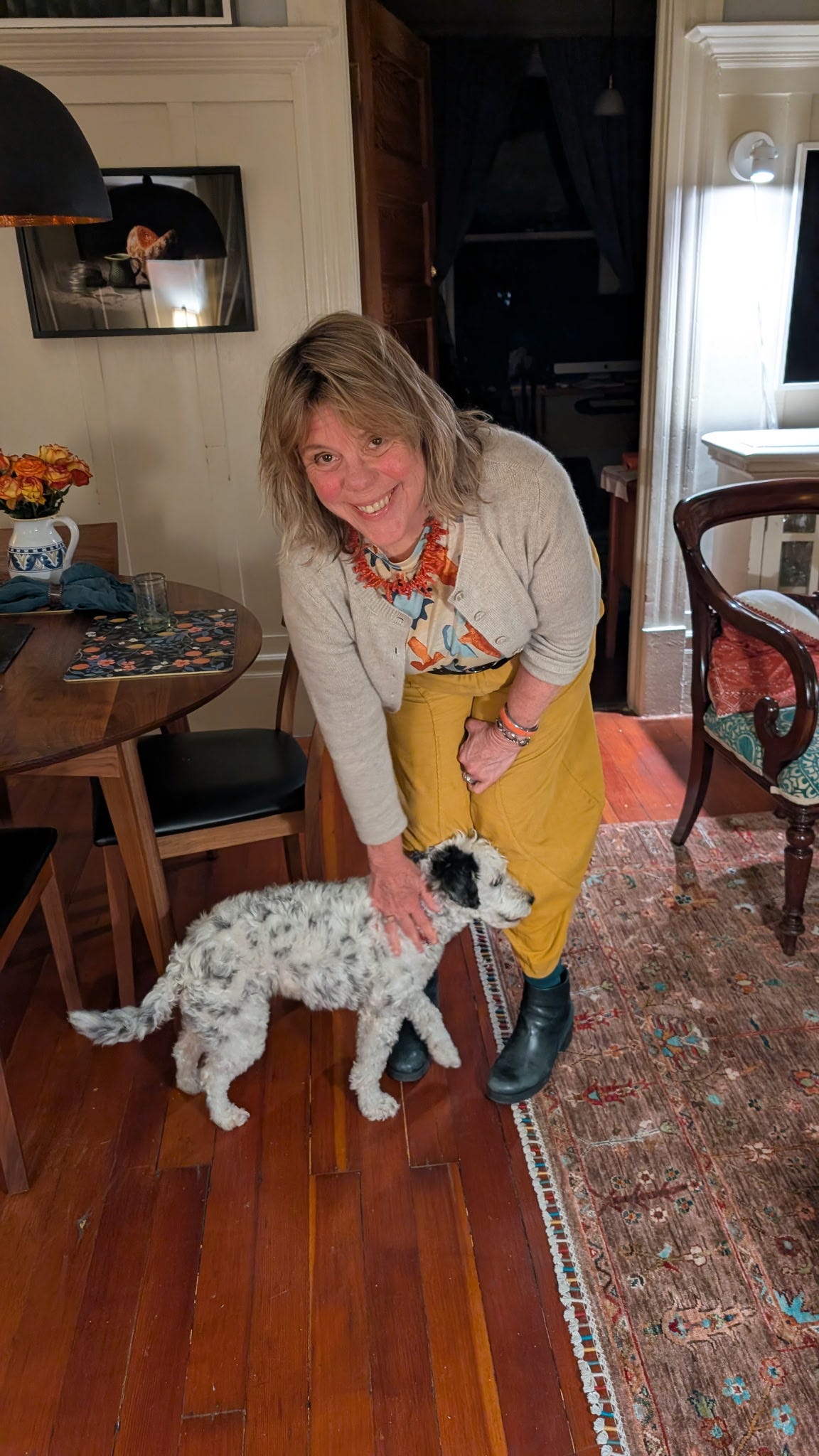
As a late in life pet owner, I can attest to the fact that there is honestly nothing like this kind of love.
What an amazing story! You and Chita were meant for each other and I love stories about animal rescue. I hope the next time you come here, I'll get to meet Chita, too. ❤️